
How Physiotherapy Can Help with Jaw Pain
- Ultra Sports

- Sep 18, 2025
- 5 min read
Updated: Sep 23, 2025

Jaw pain is more common than most people think. Roughly 10-15% of British adults experience jaw pain at some point. But many of us just ignore it. We think it might be toothache or caused by nocturnal jaw clenching. Some of us put it down to stress. But what most people don’t realise is that physiotherapy can help.
There are a whole range of reasons for jaw pain, but by far the most common are those related to the temporomandibular joint (TMJ). This is the small, complex joint connecting your jaw to your skull. TMJ disorders (often referred to as TMD) can lead to a wide range of symptoms, including headaches, neck stiffness, earaches, facial pain, and difficulty chewing. If you’re experiencing any of these issues, you may benefit from contacting your local physiotherapy clinic.
How Physiotherapy Can Help with TMJ Disorders
Understanding jaw pain
The easiest way to think of the temporomandibular joint is like a sliding hinge. It enables your jaw to move to allow you to do all of the things you usually do with your mouth – talking, chewing, yawning. Because it’s one of the most used joints in the body, even minor problems with your jaw can lead to pain.
Common symptoms of TMJ disorders include:
Clicking or popping sounds in the jaw
Pain in the jaw, face, or ear
Locking of the jaw (open or closed)
Headaches or migraines
Difficulty opening the mouth fully
Neck and shoulder pain
So, why do these symptoms develop? Really, it can be any number of things, and it’s often a combination of many. Common causes include poor posture, injury, stress-induced jaw clenching, and even strain from dental work, such as holding the mouth open for long periods. Other conditions, like arthritis, can also cause jaw pain.
The problem is that jaw pain is rarely just that. You may be most aware of the pain in your jaw, but more often than not, other muscles are also impacted. In some cases, TMJ is even linked to issues with the spine. So, getting checked shouldn’t be delayed too long.
How physiotherapy can help with jaw pain
So, where does physiotherapy come in? As with any other injury, a physiotherapist can help you to work out the reason for your pain. They can assess whether there are any other related issues at play. And, importantly, recommend a range of different treatments.
Manual therapy for jaw and neck muscles
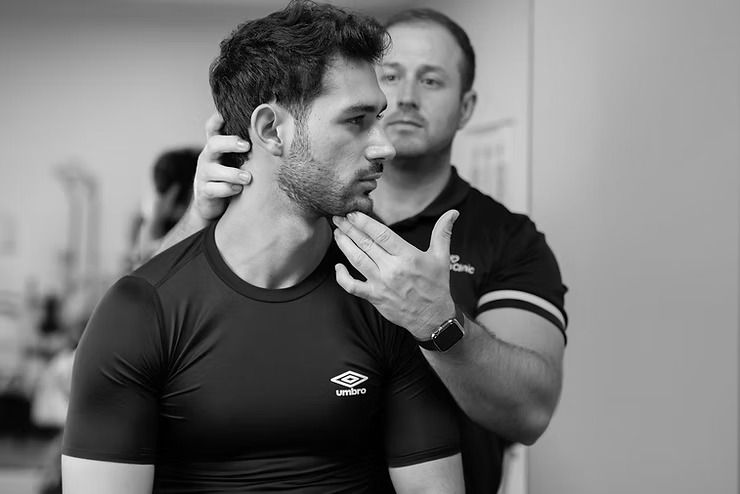
Manual therapy can be a key part of any physiotherapy treatment. Including techniques such as joint mobilisations, soft tissue massage, and trigger point release, it can help to reduce muscle tension. With jaw pain, this can help to relax the muscles and improve alignment.
Postural correction
It may not be immediately obvious how poor posture can have any bearing on jaw pain. But postural alignment is actually an important part of preventing jaw pain. Imagine you’re sitting at a desk for hours every day. This inevitably impacts your posture. Without thinking, you sit with your head and shoulders tilted forward. The problem is that this position puts strain on both your jaw and neck muscles, compressing the jaw joint. This makes the muscles you use to close your jaw work much harder. Over time, this can change the way you bite, which exacerbates the pain. A physiotherapist can help you to identify these issues and guide you through exercises to correct them.
Therapeutic Exercises
There are lots of different therapeutic exercises that your physiotherapist can recommend to help relieve your jaw pain. In the process, you’ll also improve your muscle strength in your jaw, neck, and shoulders. And increase the movement of your jaw. These work in a range of ways, but will usually involve:
Controlled jaw opening and closing
Side-to-side movement of the jaw
Neck strengthening and stretching.
Education and lifestyle advice
One of the reasons why people experience problems like jaw pain repeatedly is because they don’t understand what they are doing to cause it. That’s why physiotherapy is often as much about education as it is treatment. So, your physio may offer advice on how to reduce strain on your jaw, whether that’s better stress management or correcting your sleep posture.
Dry needling and shockwave therapy
Some physiotherapy clinics also offer dry needling or shockwave therapy. These are usually offered in addition to the other treatments for patients who have experienced pain for some time. Their purpose is to treat deeper muscle tension and inflammation in ways that work through different physiological mechanisms than traditional manual therapy.
Why you shouldn’t ignore jaw pain
The problem with jaw pain is that it’s easy to convince yourself that it doesn’t really matter. You’re making a fuss. It’s not like it’s going to do any long-term damage. But if you don’t seek help, TMJ disorders usually get worse.
So, even if your jaw pain is mild or only happens occasionally, it's worth having an assessment. If nothing else, it can reassure you that there’s nothing to worry about. But in most cases, it will help you to deal with the problem before it gets out of hand.
The knock-on effects of jaw pain
For most people, jaw pain isn’t an isolated problem. Because it’s connected to the cervical spine, cranial nerves, and facial muscles, it can cause referred pain and problems in many other areas.
Common knock-on effects of TMJ disorders:
Tension headaches from muscle tightness in the temples and neck
Ear pain or a feeling of fullness, even when there’s no infection
Neck and shoulder stiffness due to compensatory posture
Dizziness or vertigo, due to the close proximity of the inner ear and jaw
Poor sleep from pain or jaw clenching at night
Treating jaw pain without looking at what else might be going on often means that you end up treating the symptom rather than the cause. That’s why physiotherapy is usually a good bet. It takes more of an holistic approach to pain to provide longer-term results.
What to expect from your physiotherapy appointment
OK, so you’ve made a physiotherapy appointment. Here’s what you can expect:
Initial assessment
Your physiotherapist will take a detailed history and assess:
Jaw movement and symmetry
Muscle tenderness or tightness
Posture and neck alignment
Bite alignment (possibly suggesting collaboration with a dentist if needed)
Treatment plan
A custom plan will be developed based on your needs. This may include:
Hands-on treatment
Home exercise programmes
Advice on ergonomics, habits, and stress management
Progress monitoring
Your physiotherapist will continuously adjust your treatment according to how you respond to it. So, if you don’t experience immediate results, don’t panic. At the start of every session, your physio will ask you how you’ve been since your last appointment and whether you’ve experienced any improvements. They’ll then reassess your movement and muscle tightness before determining the next phase of your treatment.
Some of the best physiotherapy clinics in London offer multi-disciplinary care, which may include collaboration with dentists, GPs, and osteopaths to ensure full-spectrum treatment.
Key takeaways
Jaw pain is often a sign of TMJ dysfunction, which can affect your entire musculoskeletal system.
Physiotherapy offers a non-invasive, holistic solution that addresses the root causes of jaw pain, not just the symptoms.
Common treatments include manual therapy, posture correction, therapeutic exercises, and lifestyle education.
Early treatment can prevent long-term complications such as headaches, neck pain, or chronic tension.
A reputable physiotherapy clinic in London can provide a tailored recovery plan, often with faster and more sustainable results than passive treatments.
Is it time to book an appointment?
If you’ve been ignoring jaw pain or if your current treatments aren’t working, consider booking an assessment at a physiotherapy clinic. It’s the best way to prevent your symptoms from escalating and causing longer-term problems.
Are you looking for physiotherapy in London? Ultra Sports Clinic can help.


Comments